
In a longitudinal follow-up analysis,
Patients remained in complete response for a median of ~4 years1,2
In the 41 patients who achieved initial complete response (CR) in Urogen's Olympus study,
Median duration of response*
(95% CI: 13.0, NE)1,2
Median follow-up: 28.1 months (95% CI: 13.1, 60.1)2


In the 20 patients who consented to a long-term follow-up study and maintained CR,
Study overview: A total of 71 patients were enrolled and treated in the parent Olympus study. Of the 71 patients, 41 achieved CR at 3 months after treatment with 6 weekly instillations of JELMYTO and entered quarterly follow-up for 12 months, after which 20 of those were enrolled in the 5-year rollover trial and were followed for evidence of recurrence, progression, or death by their treating physicians on a semiannual basis. The primary analysis evaluated DOR in the 41 patients who achieved CR. The statistical methods described above were repeated in the subset of 20 patients who were analyzed for efficacy in the follow-up trial.1,2
Study limitations: This is a post hoc analysis, and the parent study was a single-arm trial. That study design was carried into this long-term follow-up. A small number of patients entered into this study, for whom there was an inherent selection bias. Additionally, no safety or quality-of-life data were collected.1,2
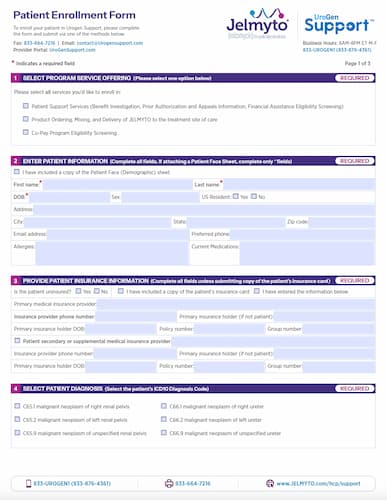
Featured resources
Download these resources to learn more and to get your appropriate patients started on Jelmyto treatment.


Indications and Usage
Jelmyto® (mitomycin) for pyelocalyceal solution is indicated for the treatment of adult patients with low-grade Upper Tract Urothelial Cancer (LG-UTUC).
Important Safety Information
Contraindications
Jelmyto® (mitomycin) for pyelocalyceal solution is contraindicated in patients with perforation of the bladder or upper urinary tract.
Warnings and Precautions
Ureteric Obstruction
Ureteric obstruction, including ureteral stenosis and hydronephrosis, occurred in patients receiving Jelmyto. Monitor patients for signs and symptoms of ureteric obstruction, including flank pain, and fever, and for changes in renal function. Patients who experience obstruction may require transient or long-term ureteral stents or alternative procedures. Withhold or permanently discontinue JELMYTO based on the severity of ureteric obstruction.
Bone Marrow Suppression
The use of Jelmyto can result in bone marrow suppression, particularly thrombocytopenia and neutropenia. The following tests should be obtained prior to each treatment: Platelet count, white blood cell count differential and hemoglobin. Withhold JELMYTO for Grade 2 thrombocytopenia or neutropenia. Permanently discontinue for Grade 3 or greater thrombocytopenia or neutropenia.
Embryo-Fetal Toxicity
Based on findings in animals and mechanism of action, Jelmyto can cause fetal harm when administered to a pregnant woman. In animal reproduction studies, administration of mitomycin resulted in teratogenicity. Advise females of reproductive potential to use effective contraception during treatment with JELMYTO and for 6 months following the last dose. Advise male patients with female partners of reproductive potential to use effective contraception during treatment with JELMYTO and for 3 months following the last dose.
Adverse Reactions
Common Adverse Reactions
The most common adverse reactions in ≥ 20% of patients treated with Jelmyto were ureteric obstruction, flank pain, urinary tract infection, hematuria, renal dysfunction, nausea, abdominal pain, fatigue, dysuria, and vomiting.
Additional Adverse Reactions Information
Selected clinically relevant adverse reactions in < 10% and ≥ 2% of patients who received Jelmyto include urinary tract inflammation, bladder spasm, urosepsis, hypersensitivity, and instillation site pain.
Use in Specific Populations
Lactation
Because of the potential for serious adverse reactions in a breastfed child, advise women not to breastfeed during treatment with Jelmyto and for 1 week following the last dose.
Preparation and Administration Information
Jelmyto is for pyelocalyceal use only and not for intravenous use, topical use, or oral administration. Jelmyto must be prepared and administered by a healthcare provider. To ensure proper dosing, it is important to follow the preparation instructions found in the JELMYTO Instructions for Pharmacy and administration instructions found in the JELMYTO Instructions for Administration.
Jelmyto may discolor urine to a violet to blue color following the instillation procedure. Advise patients to avoid contact with urine for at least six hours post-instillation, to void urine sitting on a toilet, and to flush the toilet several times after use.
Jelmyto is a hazardous drug. Follow applicable special handling and disposal procedures.
Please click here for Full Prescribing Information.
References: 1. Pierorazio PM, Kleinmann N, Shabsigh A, et al. Long-term outcomes of primary chemoablation of low-grade upper tract urothelial carcinoma with UGN-101, a mitomycin reverse thermal gel. J Urol. 2025;213(3):313-322. 2. Brito J, Hu B, Kleinmann N, et al. Long-term outcomes of treatment of low-grade upper tract urothelial carcinoma with UGN-101, a mitomycin reverse thermal gel. Presented at: New England Section of the American Urological Association; September 5, 2025; Boston, MA.